Which Canon Mirrorless is Right for You? | Tony & Chelsea
Tony & Chelsea Review Canon Mirrorless Cameras
Tony & Chelsea Northrup review EVERY Canon RF mirrorless camera, including the Canon EOS R10, Canon EOS R7, Canon EOS R6, Canon EOS R5, Canon EOS R3, Canon EOS R, and Canon EOS RP. Which one is right for you depends on your budget and whether you shoot sports & wildlife.
VIDEO TRANSCRIPT
Chelsea: Our sponsor, Milford Photo, wanted us to help you find the perfect Canon R camera for you, so we're gonna be reviewing every Canon R camera from $1,000 to $6,000.
Tony: The first four here—the Canon R10, R7, R6, and R5—are general-purpose cameras that can do anything, including wildlife and sports. These two cameras—the RP and the R—they're better values with better image quality for people who are shooting landscapes, travel, and portraits. And finally, this big bad boy: the Canon R3. This camera is meant for serious professionals, especially pro sports shooters. Now we're going to show you each and every one and help you pick the perfect one that gives you the most bang for your buck.
Chelsea: And when you decide which camera is right for you, you can go to our sponsor's website, milfordphoto.com, and choose any of the cameras or lenses and shop. Then they have a super knowledgeable staff there to answer any questions you might have.
Tony: I way prefer shopping at a small business like that than one of the big-box businesses, but they're also great because they will answer your questions; and if you want something less than $1,000, they can help you find that. Now, let's pack up all this gear and take them out of the field so we can tell people which camera they should buy.
[Music]
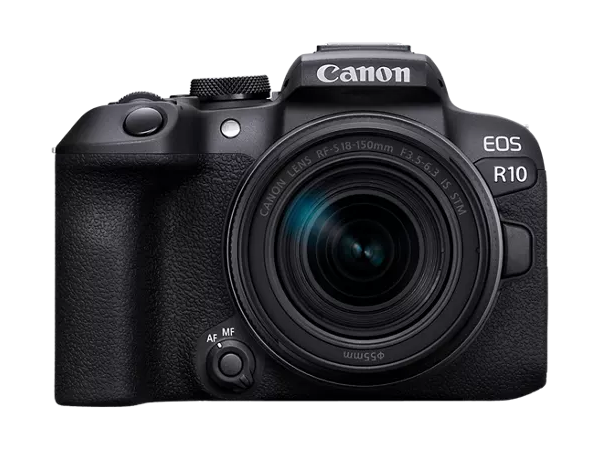
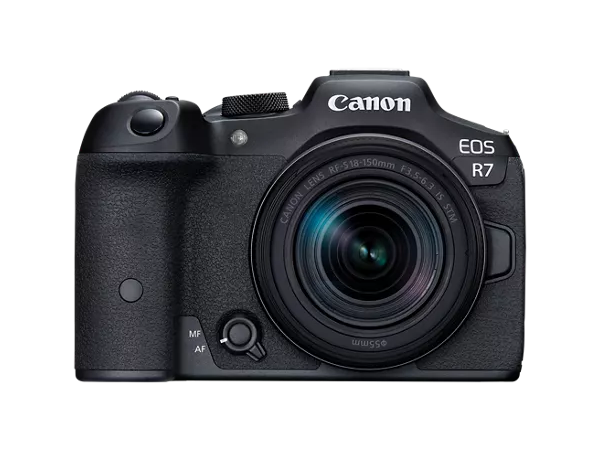
Chelsea: These are Canon's two newest R cameras, and it's the R10 and the R7. Now, the R10 is a $1,000 and the R7 is $1,500. What are you getting for that extra $500? Let's go over some specs here. With the new R10, for $1,000, you're getting 23MP, 15 frames per second with the mechanical shutter, 23 frames per second with the electronic shutter, and you get 4K 60 video cropped. How does that compare to the extra $500 that you're going to pay for this R7? Well, I think you get some pretty good features for this: you have 32MP, so you have some extra resolution if you're using good enough glass to see the difference.
Tony (voiceover): Just to prove that difference in megapixels doesn't mean anything, here's the same picture taken with the R10 and R7. Even zoomed in 1,300%, I cannot see any difference.
Chelsea: You have 15 frames per second with the mechanical shutter and 30 frames per second with the electronic shutter. Now, for this scenario, I want to point out: if you're shooting wildlife, sports, or any action with the electronic shutter, you are going to encounter something called "rolling shutter," like you can see in this picture here. So your photo might be ruined anyways if you use the e-shutter. When using these two cameras for sports, I'm gonna say they both have the same frame rate because it's both 15 frames per second with the mechanical shutter, but the R7 does have a larger buffer; and that means that you can take about twice as many photos before your buffer fills up. Let's wait till the hurricane goes away.
[Music]
Chelsea: There are still some perks at the R7 that has—it—I think are super useful, one being a stabilized sensor. That means you're not going to get as much camera shake. If your lens is not stabilized, you have the stabilized sensor to make up for that. For video, you have 4K 60 uncropped, and you also have two SD card slots so you know that if one card gets corrupted, you have the backup there. So that's a good perk.
Chelsea: The options for your kit lenses is an 18-45mm and an 18-150mm. If you're going to be shooting sports, you absolutely want the one that's going to zoom more because you're going to be standing back on the sidelines; you won't be able to get close, and you're going to need this extra reach.
Chelsea: To show you the difference between these two lenses, I'll have Tony take a few pictures of me at home plate so you could see what you'd get at a kids' baseball game.
Tony (voiceover): The 18-45mm is okay for general shooting, but this is as close as I could get for sports. The 18-150mm, on the other hand, almost fills the frame here. Let's crop them both to the same perspective so we can see the difference in sharpness. Another big advantage of the 18-150mm: when shooting at the wide end, which you'll do a lot, it's about two-thirds of a stop faster. You can see how much more light it gathers; this will drastically improve your low-light photography.
Tony: I'm here in the dugout, where I've always sat as an athlete, and I want to show you the difference between the sensors on the $2,000 and up cameras, like the R6 and the R5 and the R3, and those cameras you just saw like the R7. So, let's push in nice and tight here, and you can see the sensor on the R7 here: less than half the size of the full-frame sensor. And that's going to be a really important detail to understand because all of Canon's first R cameras had this bigger full-frame sensor, and that means all the lenses were designed for this bigger full-frame sensor.
Tony: With the R10 and the R7, you only have the choice of those two kit lenses that Chelsea showed you. Now, you can attach the full-frame lenses to the R7 and the R10, but they will be cropped in because you'll only be getting the center of the image. That means you'll be wasting more than half of the lens and spending more money than you would necessarily need to. So, until Canon releases more APS-C lenses for these smaller sensor cameras, one of the big benefits of the more expensive cameras is you'll have more complete access to the full-frame lenses and you'll have wide-angle lens capabilities.
Tony (voiceover): No, you can't currently buy any wide-angle RF lenses for the R10 or R7, but there is an answer: you could get this EF to RF adapter from Milford Photo and then pick up a super wide EF-S lens, like this 10-18mm.
Tony: Now I'll show you the differences between the $2,500 R6 and the $3,900 R5. That is a big jump in price, but the R5 is a lot of camera. The R6 here does 20 frames per second with the electronic shutter, and that's actually a useful 20 frames per second including things like sports and wildlife. But it only has a 20MP sensor. Now, that's less than the R7 and R10, but that doesn't mean the pictures are going to be worse. Because the sensor is bigger and you can use those full-frame lenses, you'll probably on average get better images.
Tony (voiceover): Just to prove that megapixels aren't everything, here's the 32MP Canon R7 on the left and the 20MP Canon R6 on the right. Zooming way in, we see about the same amount of detail, and if we look in the shadows, we can see the full-frame R6 is much cleaner. And peering into the background, we can see the nice bokeh and background separation that the full-frame sensor and professional lens give you.
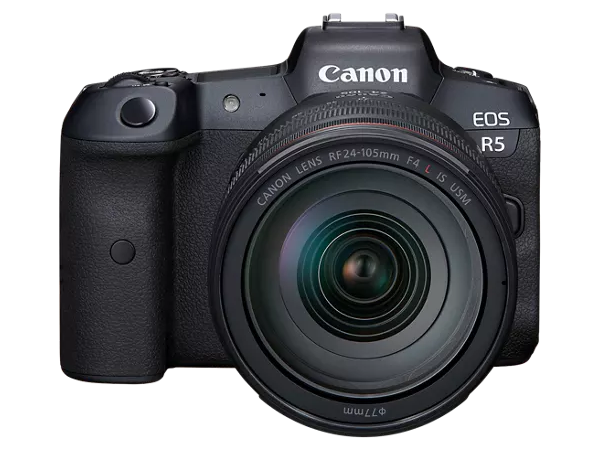
Tony: The autofocus tracking on this is absolutely amazing; and if you want to shoot video like we are, it has a flip screen like all these Canon cameras do. But the video quality on this R6 is absolutely fantastic. Like the R7, it has sensor stabilization, as does the R5. So why would you spend the extra $1,400 to upgrade to the R5? Well, this is Canon's highest megapixel R camera with 45MP. So if you love shooting landscapes and you might want to make big prints on your wall, this is absolutely amazing.
Tony (voiceover): Same photo taken with the R6 and R5. You can see the R5 has so much more detail when you zoom in. Sometimes you get what you pay for.
Tony: But if you are going to spend more to upgrade to the higher megapixel camera, you need to make sure that you also buy good quality glass for it, like this Canon 24-70mm. Most photographers will spend more money on the lenses than the body, so I don't want to see you spending this much on an R5 and then putting the entry-level glass on it. If you do that, instead I would recommend you get the lower megapixel R6; otherwise, you'll just be generating big files without any more detail.
Tony: Now, if you are shooting video, the R5 has a couple of advantages: it can shoot 8K at 30 frames per second, and it's a RAW file. That means you can recover the highlights and the shadows, and you get just incredible dynamic range. That is incredible amounts of detail—way more than any of us really need—but if that does sound appealing to you, the R5 is absolutely powerful. Just be sure you buy really, really big memory cards.
Tony: And memory cards are another difference here too: the R5 has two memory cards, as did the R6 and R7, but this one has a CFexpress Type B card. That is this bigger card that can offload your pictures faster. That means for sports and wildlife where there's long action sequences, you'll be able to take more pictures before it starts buffering.
Tony: I also feel like the R5 feels like a more luxurious camera than the other cameras. It has a bigger, sharper viewfinder here, a better rear screen, it has this very nice top screen, and overall it's just an amazing camera to use. I think the R5 is the best overall camera capable of doing anything: sports, wildlife, and landscapes. But I do want to show you one more sports camera before we leave this field.
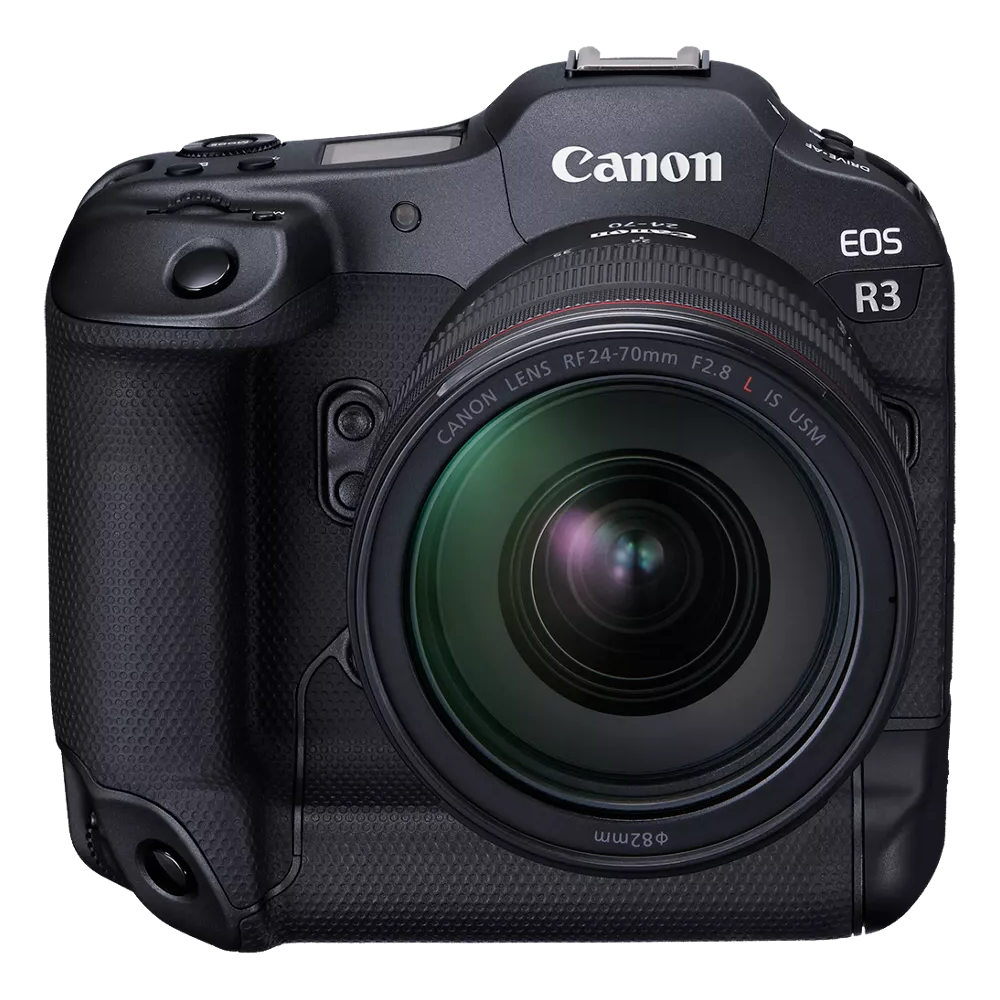
Tony: This is the Canon R3. It has a beautiful top screen, big rear screen, a vertical grip so you can hold it vertically, a massive battery so you can shoot all day; and for the really serious pros, it has features like a physical Ethernet port so you can offload your photos to your editor. And it is $6,000, but you do get what you pay for. If that's way out of your budget, just hold on: we're going to talk about much lower budget options in just one second because the good folks at Milford Photo have you covered. But if you're curious, listen to what this sounds like... Each one of those is a beautiful 24MP picture taken at 30 frames per second. And for things like golf, it can shoot silently and you don't have that problem of rolling shutter.
Tony: And for subjects that don't require autofocus or auto exposure, the R3 can shoot at up to 195 frames per second for about 50 shots, or about a quarter of a second. Notice how minimal the rolling shutter is. Amazing!
Tony: Now, this is the ultimate sports camera in the Canon lineup, but it's not as high megapixel as that R5; and that means that it's not as good at being a general-purpose camera.
Tony (voiceover): But the R5 has 45MP—that's almost twice as many as the R3's 24MP. Portrait photographers could use that detail to make bigger, higher-end, more expensive prints.
Tony: Also, if you ever want to travel with your camera, it's kind of big; it's also the opposite of discrete and it might make some people a little bit nervous. And for me, that's why I prefer the R5 for most things except for dedicated sports shooting.
Tony: This R3 also has a really cool trick up its sleeve: it knows where you're looking. So you can turn on eye-tracking autofocus, and when you hold the camera up to your eye like this, wherever you look, it follows your eye and locks onto focus. But I'll say, I don't really recommend people spend a lot for that—it's kind of gimmicky. I tried living with it for about a week and ultimately just ended up turning it off because it needs to be reset just about every time you use it. Now I do want to talk about those lower budget options, so let's take a walk through the woods here.
[Music]
Chelsea: These are the Canon R and RP cameras, and they're about the same price as the new R7 and R10. The RP is $1,000 and the R is $1,800. Um, the difference between the two cameras is not that much, but they are significantly different than the R7 and R10. Let me break it down for you. So these are full-frame cameras; that means that you're going to get better image resolution. The less expensive RP has like 26MP and the R has 30MP. It's not a huge difference.
Tony (voiceover): I'll show you the exact difference. You can see even at 1,300% with a professional lens, there's no difference in sharpness. But maybe dynamic range: in really heavily recovered shadows, we can see the R is quite a bit cleaner than the RP. If you don't plan on shooting RAW and recovering shadows at least three stops, the RP should be just fine.
Chelsea: The frame rate—there's also not a big difference. The RP has five frames per second and the R has eight frames per second, so there's not a big difference in the frame rate between these two. But with the R7 and the R10, they're no match for sports. You would not want to shoot these for sports. You would want these if you want the higher resolution and the full-frame sensors for shooting high-resolution landscapes, travel, things like that.
Chelsea: The difference between the two other than price is that the RP is lacking a few bells and whistles: the screen isn't as high-res, the EVF isn't as high-res. But the R has a few nicer features: it's got the screen on the top, so this is like the luxury version of this camera. Everything's just a bit nicer. Even though the RP is their entry-level camera, it's still a great camera, and we have six of them that we use in our studio because the image resolution is great, the video is great, the dynamic range is good, and they're a good value. My favorite walking-around lens is very versatile: it's the 24-240mm.
[Music]
Tony: That was a lot of information. Let's recap real quick. If you're not a sports shooter, family pictures, travel, landscapes—I'm gonna steer you towards the Canon RP at about $1,000 or the Canon R at about $1,700. The images are going to look pretty much the same, but the Canon R feels a little bit better. And if you have more budget, then the $3,900 Canon R5 produces really high-quality images with its high-megapixel sensor. But please make sure you set aside money to get good lenses for it, like this 24-70mm f/2.8. I don't want to see you with a super expensive body and inexpensive lenses because then you're just wasting your time.
Chelsea: If you are shooting sports, we're going to recommend the R10, R7, R6, and the R3 in that order, depending on your budget. The R10 is $1,000, the R7 is $1,500, the R6 is $2,800, and the R3 is $6,000. Be sure to leave room in your budget for a good lens.
Tony: And if you're shooting some sports where you're not a dedicated sports shooter, I think the best all-around camera for an unlimited budget is the Canon R5. It has amazing ability for wildlife and sports and landscapes and portraits. It just—it also requires a really high budget.
Chelsea: If you're looking to shoot wildlife specifically, we're going to recommend the R10, the R7, and the R5; and again, that goes by your budget. If you can afford the R5, definitely go for that. If you're wondering why we didn't choose the R3 for wildlife, it's because it has 24MP, so you're not getting the same resolution, and it also has an AA filter, which means that it's not as sharp.
Tony: Please check out milfordphoto.com. They are the nicest camera store around. I love supporting a small business that is our local store, and if you're in the Connecticut area or you're traveling through there, definitely stop by
Chelsea: You have to stop in!
Tony: and see everything in person. The people there are so nice and so helpful. And even if you're shopping online, they can help you answer the questions because I know it's really complicated and you're spending a lot of money and you want to make sure you're getting the most bang for your buck.
Chelsea: Yeah, I think it's also just fun to stop in. We love visiting the store. They have lights—you can actually get your hands on them. They have a whole place where you can go and you can try all of the lights, you can feel the tripods, you can get a feel for everything that you're thinking about buying. And they even have film cameras, prints—if you're looking for a great place to print your photos, they have it all. It's a one-stop shop. They're friendly, it's a small business, it's legit—you're going to love it. So try them out.
Tony: And don't forget to subscribe to our channel. We have the R10 review coming out really soon, as well as tutorials for these cameras. Thanks so much. Bye!